Mitigating Missing Data in Digitally-Derived Clinical Trials: A Proactive Clinical Operations Framework
As digital health technologies (DHTs), wearables, and decentralized clinical trial models become standard in modern drug and device development, digitally-derived endpoints offer unprecedented continuous monitoring capabilities. However, continuous data collection brings a critical challenge: missing data. While clinical operations teams traditionally account for patient attrition by expanding initial sample sizes, regulatory authorities—including the FDA—are placing greater scrutiny on missing data mechanisms. This article outlines key takeaways from recent FDA/Duke-Margolis Institute discussions and presents a proactive, operational framework for clinical teams to prevent and mitigate missing data before protocol finalization.
Key Takeaways from FDA & Duke-Margolis Workshop on Digitally-Derived Endpoints
At a joint workshop hosted by the FDA and the Duke-Margolis Institute for Health Policy on statistical and operational considerations for digitally-derived endpoints, regulatory speakers emphasized a critical message throughout the workshop: Sponsors should consider establishing robust processes to prevent missing data rather than simply adjusting for it.
Key operational insights include:
Regulatory Scrutiny: The FDA and biostatisticians examine not just the volume of missing data, but the underlying reasons behind missing data points.
Proactive Prevention: Relying on statistical imputation or over-enrollment to buffer against data gaps is not considered sufficient.
Cross-Functional Integration: Clinical operations, biostatistics, and data management must collaborate early during study design to model scenarios where missing data could compromise trial success.
The True Cost & Impact of Missing Data on Product Evaluation
When a patient fails to record site-specific data or wear a monitoring device at required timepoints, the missing datapoint can significantly affect the safety and efficacy narrative of the product:
Unanswered Safety Signals: Is a gap in data transmission caused by patient oversight, or did the patient stop wearing the device due to an unreported adverse event or treatment-induced discomfort?
Efficacy Masking: If a patient non-reports data because they feel better (or conversely, because they experience no improvement), missing data introduces systematic bias that distorts outcome measures.
Regulatory and Financial Delays: Inadequate endpoint data may require protocol amendments, trial extensions, or additional patient cohorts—adding substantial cost and delaying time-to-market.
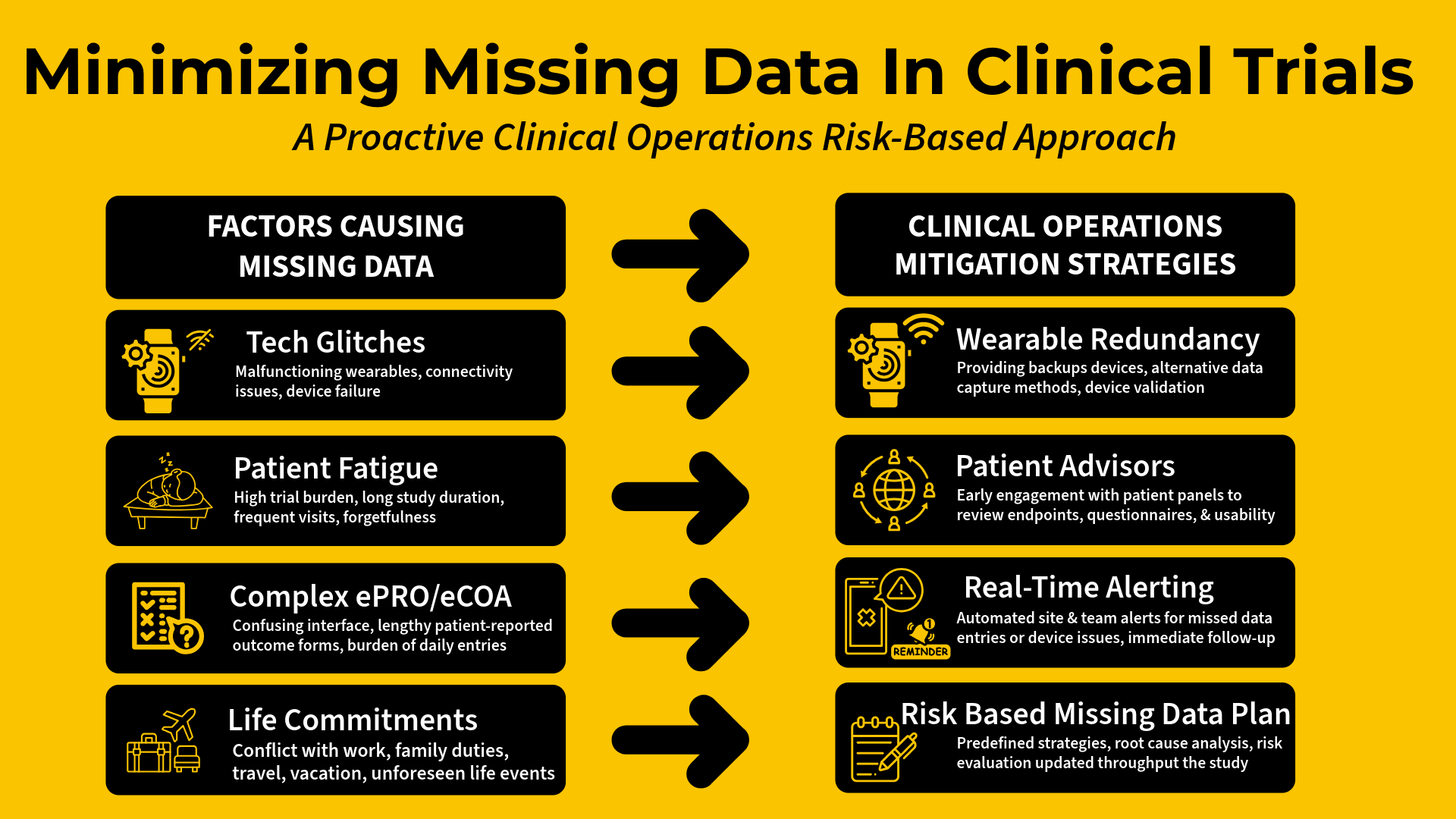
Real-World Challenges & Patient Attrition Factors
Preventing missing data requires understanding why patients drop out or fail to transmit digital data. Common real-world barriers include:
Life & Travel Commitments: Vacations, work schedules, and family obligations frequently cause interruptions in scheduled digital entries.
Technology Friction: Software glitches, Bluetooth syncing failures, complex ePRO questionnaires, and battery charging demands create burden for participants.
Perception of Benefit: Patients who feel immediate symptomatic relief—or no change at all—may lose motivation to comply with continuous digital reporting over long study durations.
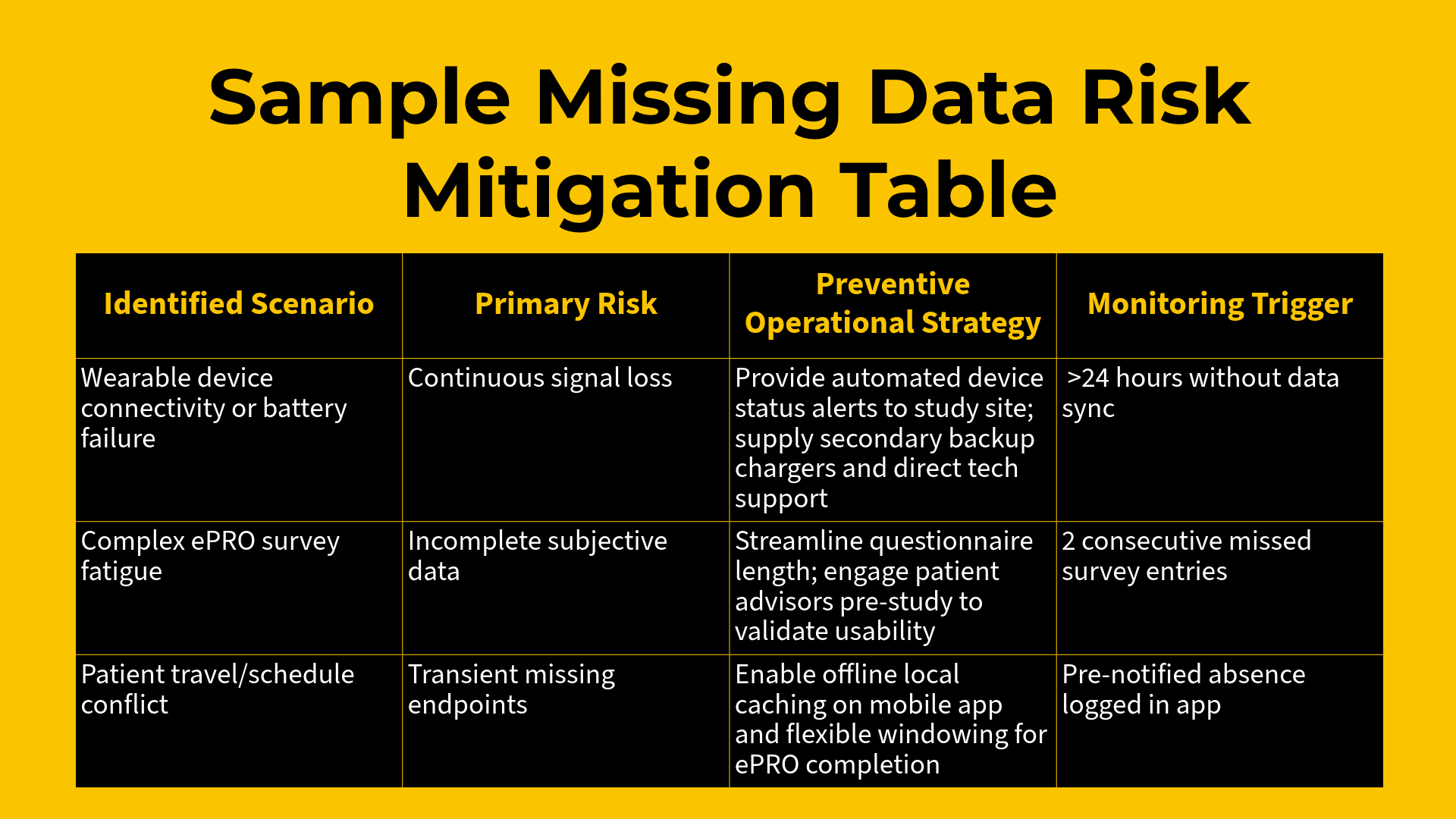
Proactive Risk Mitigation: Building a Missing Data Plan & Risk Assessment and Mitigation Table
To move beyond simple sample-size inflation, Clinical Operations teams should implement a dedicated Missing Data Plan (MDP) backed by a structured Risk Assessment and Mitigation Table during trial design.
Involving Patient Advisors & Continuous Trial Monitoring
A patient-centric Missing Data Plan can incorporate participant feedback prior to protocol finalization and relies on continuous, real-time monitoring throughout study execution.
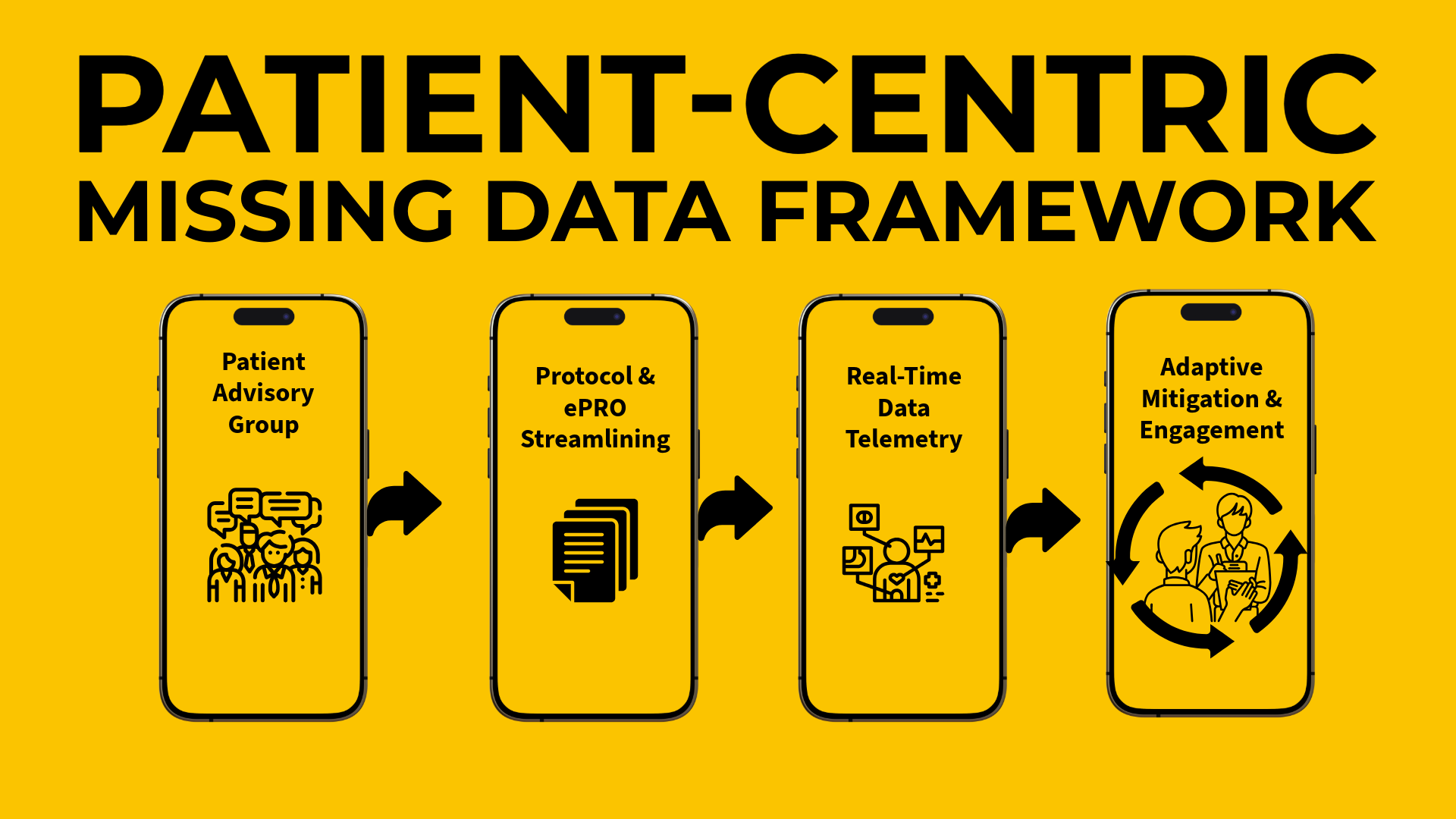
Engage Patient Advisors Early: Include patient focus groups to review digital tools, survey questions, and wearable schedules. Identifying confusing prompts or hardware inconveniences early prevents non-compliance.
Establish Telemetry & Alerts: Implement automated telemetry dashboards that notify site coordinators when a participant stops transmitting data, enabling immediate support.
Iterative Protocol Governance: Revisit missing data patterns during trial conduct to implement corrective actions before data integrity is compromised.
Conclusion & Actionable Next Steps for Clinical Operations Teams
Developing a comprehensive Missing Data Plan adds upfront effort during protocol planning, but it safeguards trial success, protects regulatory timelines, and preserves the true value of digitally-derived endpoints.
Actionable Next Steps:
Incorporate a formal Missing Data Risk Assessment into early protocol development checklists.
Partner biostatisticians, data managers, with clinical trial managers to establish clear trigger thresholds for data non-compliance.
Conduct usability testing with patient advisory panels on all ePROs and digital health technologies.